
What is Logics?
Logics is a classical speed test assessing multiple cognitive abilities and GMA (General Mental ability). The assessment consists of 80 items to be completed within 30 minutes. The respondent is free to navigate between, answer and skip tasks as they prefer. There is no time limit on the individual items; however, time spent on the different kinds of items is tracked and displayed in the results.
The assessment is currently available in 15 languages:
- Danish (DK)
- Dutch (NL)
- English (GB)
- English (US)
- Estonian (ET)
- Finnish (FI)
- French (FR)
- German (DE)
- Italian (IT)
- Latvian (LV)
- Lithuanian (LT)
- Norwegian (NO)
- Polish (PL)
- Spanish (ES)
- Swedish (SV)
The model behind Logics
Logics was developed on the basis of classical intelligence theory, in particular Charles Spearman’s distinction between a general (g) factor and specific (s) factors, as well as Raymond Cattell’s distinction between fluid and crystallized intelligence. The various parameters in Logics thus constitute a broad and relevant selection of the aspects that define intelligence according to many years of international research. The test also provides detailed information about the test person’s learning capability, efficiency, and decision style, which makes Logics particularly relevant in a business context.
The hierarchical structure of parameters in Logics and how they relate to classical intelligence theory is illustrated below. These hierarchical layers (or strata) mirror the Cattell-Horn-Carroll Theory of Cognitive Abilities, which has received extensive empirical support throughout several years of research (Flanagan & Dixon, 2014). In addition, the parameters in Decision style (Speed and Accuracy) and the GMA score are calculated based on the full set of items, and Learning capability is based on a subset of items within Logical capacity with fluid intelligence as the basis for future learning.
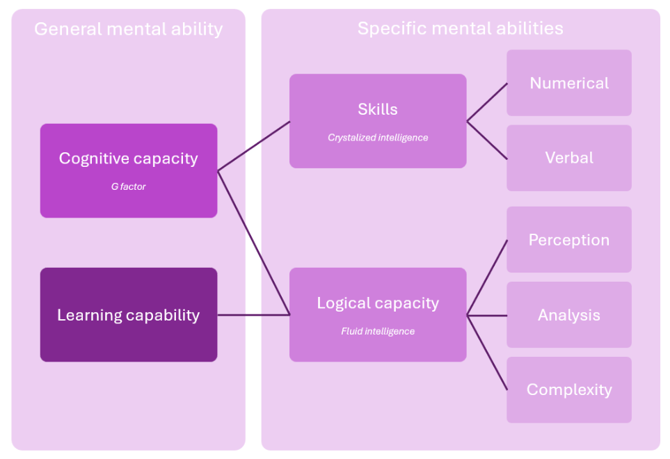
Scale definitions and interpretations
Cognitive capacity
A measure of the general mental ability/overall intelligence, which examines the overall cognitive capacity compared to a norm. The GMA score is calculated on the basis of all tasks in the test and is a complex function of the test person’s speed and accuracy in their completion of the test. The GMA score has an equal weighting of fluid and crystallized intelligence. The score reflects the underlying factor that can explain the individual’s ability to quickly and precisely solve and learn how to solve different cognitive tasks of different familiarity (known as the g factor).
Learning capability
The measure of Learning is based on tasks from Logical Capacity, which measure fluid intelligence and examines the person's capability to solve novel logical problems without any prior knowledge, regardless of whether the person has had enough time to see and solve all the cognitive tasks in the test.
Decision style
Information about a person's problem-solving strategies based on the prioritization of speed and accuracy in the person's completion of the entire logical test.
Speed
Speed measures how fast the person draws conclusions and makes decisions when presented with cognitive tasks. Speed measures what percentage of tasks the person has answered in total. The result on Speed must be considered in relation to the score on Accuracy.
Accuracy
Accuracy measures correctness, which examines how accurate the person is in their conclusions on cognitive tasks. Accuracy measures what percentage of the person's answered tasks have been answered correctly. The results must be considered in relation to the score on Speed.
Logical capacity
Information about a person's fluid intelligence based on abstract reasoning tasks that examine the ability to understand, analyze and handle complex information when exposed to novel logical problems.
Perception
Perception is a measure of logical comprehension, which examines the person's ability to recognize patterns and see logical connections. The tasks that measure Perception are designed to be difficult to understand but easy to solve and they consist of largely non-verbal figures and illustrations. Therefore, Perception is the one of the five areas which is least dependent on language abilities.
Analysis
Analysis is a measure of logical reasoning, which examines the person's ability to think rationally and process logical information in a systematic way. The tasks that measure Analysis are designed to be easy to understand but difficult to solve and they are based on a verbal source of information.
Complexity
Complexity is a measure of the ability to handle complex information, and it examines how a person uses logical deductions to comprehend and navigate complicated logical tasks. The tasks that measure Complexity all hold a lot of information that the person needs to keep track of at the same time. Therefore, Complexity is the one of the five areas which is most time consuming to complete.
Skills
Information about a person's crystallized intelligence examining verbal and numerical reasoning skills based on tasks, which require acquired information and prior knowledge to solve them properly.
Numerical
Numerical is a measure of numerical reasoning, which examines number sense and mathematical skills. The Numerical tasks include basic calculations and arithmetic problem-solving.
Verbal
Verbal is a measure of verbal reasoning, which examines the understanding of language, grammar and linguistic abilities in the test completion language. The Verbal tasks are typically built on word comprehension and basic grammar.
Response patterns
In addition to the normed scores, detailed response patterns are shown for each scale depicting the overall C score alongside the proportion of correct, incorrect, skipped, and not seen tasks as well as a speed indicator grouped into quick/average/slow. The numbers are circled with colors according to the rules shown in the table below:
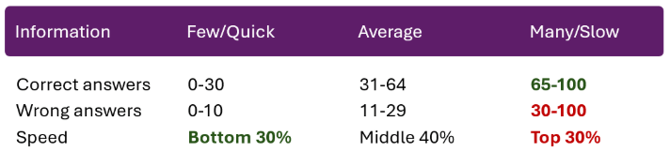
Adverse conditions
The items in Logics are not entirely figure based and hence places higher demands on reading comprehension and language proficiency. Therefore, results might be affected by adverse conditions such as:
- Dyslexia or other reading disabilities
- Completion in a non-native language
- Dyscalculia (difficulty in understanding and working with numbers)
The level of influence of the above-mentioned adversities on individual results can’t be estimated in a standardized way, as each individual’s disadvantage differs and because other aspects, such as overall GMA, affect the individual capacity too.
The assessment is accessible and can be completed using only the keyboard.