
1. Framework as the Foundation for Assessments
The Assessio Performance Framework functions as the behavioral backbone for all Assessio assessments and insights tools. It ensures that every data point — from personality to cognitive ability — can be translated into competencies and performance predictions aligned with organizational outcomes.
The framework connects directly to:
-
MAP (personality-based behavioral predictors)
-
Matrigma (general mental ability measure)
-
Assessio Lenses (competency-based job and organizational profiles)
-
Leadership Feedback (team-based performance calibration)
- Onboarding and Development insights (competency based and actionable insights)
By using a single shared structure, Assessio ensures that all outputs are scientifically coherent, behaviorally consistent, and practically interpretable
2. From Assessment Data to Competency Scores
Each assessment response is first translated into standardized scale scores (Z-scores, C-scores, and percentiles) and then mapped to competencies using a weighted model.
-
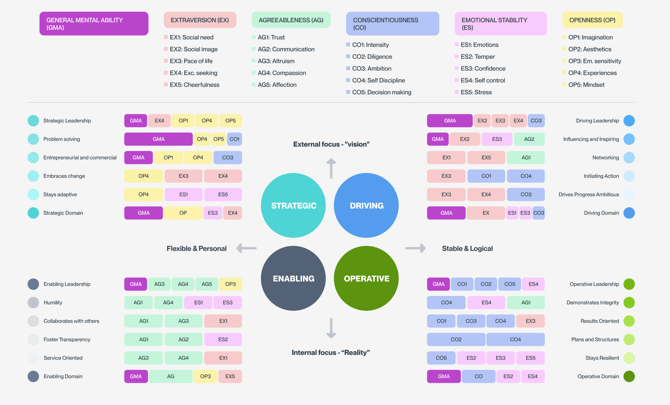
MAP and Matrigma scales are combined into 16 behavioral competencies (specialist) or 4 leadership domains.
-
Each competency is measured through 2–5 test scales, each carrying a defined weight.
-
Weighted percentile scores form a compound competency percentile.
-
Competency scores are then transformed into match scores representing whether a behavior is underused, just right, or overused.
-
Finally, all competency scores are aggregated into Lens match scores, weighted by the importance of each competency within that lens.
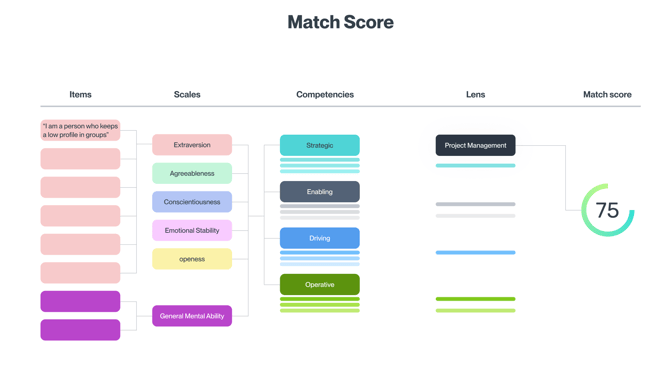
This process ensures a transparent and consistent bridge between psychometric data and real-world job performance.
3. Assessio Lenses
Assessio Lenses are predefined or customizable competency profiles that represent the behavioral requirements of a role, team, or strategy.
Each lens contains:
-
4–7 competencies, covering all four performance domains.
-
Weightings that reflect the role’s strategic vs. operative and driving vs. enabling balance.
-
A built-in logic ensuring at least one competency per domain to maintain holistic behavioral representation
Lens Types
-
Off-the-shelf Lenses:
Over 50 standardized profiles mapped to 500+ O*NET jobs, aligned with the Assessio Performance Framework. These lenses can be applied directly to recruitment or development use cases. -
Custom Lenses:
Created using the Lens Maker tool, allowing users to create new lenses from scratch or adjust/boost Assessio lenses (e.g., increasing Strategic focus) to match strategic or cultural needs while maintaining internal validity constraints.
4. Dynamic Score Transformations
Assessio applies dynamic transformation models to competency scores to ensure interpretability across varying levels of cognitive ability (GMA weighting)
-
Competencies with higher GMA loadings (e.g., Problem Solving) are adjusted to prevent inflated or deflated match scores.
-
The system applies adaptive thresholds that account for underused, just right, and overused patterns across different GMA weightings (0–60%).
-
These transformations improve both fairness and predictive accuracy across roles and populations.
The result is a more stable and valid match score, resilient to cognitive ability variance.
5. Insights and Reporting
All assessment results and match scores are translated into behavioral insights within the Assessio platform:
-
Recruitment Context:
Lenses highlight behavioral fit between candidates and job profiles, visualizing strengths, risks, and development areas. -
Development Context:
Insights show where employees over- or underuse certain competencies, guiding tailored learning or coaching actions. -
Leadership Feedback Integration:
Leader behavior data is benchmarked against domain expectations, supporting actionable feedback loops across teams
These insights can be viewed as:
-
Visual dashboards for HR analytics,
-
Candidate reports for recruitment,
-
Development summaries for coaching and internal mobility.
6. Integration with Organizational Strategy
The consistent behavioral architecture allows results to be aggregated across:
-
Individuals → Teams → Organizations,
-
Enabling people analytics that connect competency distributions to strategic KPIs such as innovation, engagement, and efficiency.
For example:
-
An organization emphasizing a Brand Strategy might observe higher Driving domain scores in successful teams.
-
A Service Strategy organization may correlate higher Enabling domain scores with improved customer satisfaction.
This integration transforms Assessio’s assessments into a strategic decision-support system, not just diagnostic tools