
1. From Behavior to Organizational Performance
The foundation of Assessio’s model is that behavior drives performance.
Organizations achieve strategic outcomes when people’s day-to-day behaviors align with business goals and culture.
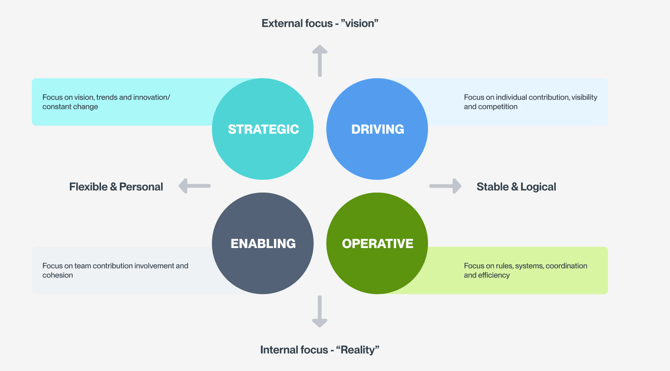
Assessio links the four behavioral domains — Strategic, Operative, Driving, and Enabling — to key organizational performance indicators (KPIs) across four major dimensions:
Performance dimension |
Example KPI´s |
Primary domain link |
| Growth | Market share, top-line revenue | Driving and Strategic |
| Productivity | ROI, ROA, sales efficiency | Operative and Driving |
| Quality / Operational Performance | Product quality, error reduction, customer satisfaction | Operative and Enabling |
| Market Adaptation | Innovation, client satisfaction, market responsiveness | Strategic & Enabling |
The framework thus provides a behavioral infrastructure for tracking how leadership and employee behaviors translate into financial, cultural, and operational results.
2. Strategy–Culture–Peopleship Alignment
Assessio’s Performance Framework connects business strategy, organizational culture, and people behaviors. Each strategy type implies a preferred culture, which in turn is reinforced by a specific behavioral domain emphasis:
Strategy |
Competitive advantage |
Cultural focus |
Dominant domain |
| Service strategy | Differentiation through customer service and cooperation | Doing things together, team cohesion, shared goals | Enabling |
| Brand strategy | Differentiation through visibility and speed | Acting quickly, setting ambitious goals, accountability | Driving |
| Quality / Innovation Strategy | First-to-market innovation and creativity | Encouraging experimentation, learning, and flexibility | Strategic |
| Price / Efficiency Strategy | Lowest cost and process excellence | Consistency, reliability, and process control | Operative |
This alignment ensures that organizational culture is not abstract — it is directly observable through the behaviors defined in the framework.
3. Leadership Behavior as a Cultural Lever
Leadership behaviors play a critical role in shaping team and cultural outcomes.
Each leadership domain contributes to distinct team-level effects that collectively determine the organization’s culture and performance trajectory.
Leadership domain |
Team effect |
Cultural impact |
| Strategic | Learning, adaptability, innovation | Increased idea generation, faster change adoption |
| Operative | Clarity, stability, and predictability | Improved delivery reliability, lower error rates |
| Driving | Clear direction and ownership | Higher goal achievement, stronger accountability |
| Enabling | Trust, safety, and engagement | Higher engagement scores, lower turnover, better collaboration |
This behavioral-to-performance chain provides a validated foundation for connecting psychometric data to business results.
5. Diagnostic and Predictive Use
By applying the framework in Assessio’s platform, organizations can:
-
Diagnose cultural and performance gaps (e.g., too much Operative focus leading to rigidity).
-
Predict areas of underperformance (e.g., weak Enabling domain correlating with poor engagement).
-
Model how team balance affects KPIs such as retention, growth, and innovation.
-
Align leadership development and recruitment with the company’s strategic focus.
These analytics allow HR and management teams to treat behavior as a measurable and optimizable business asset.
6a. Integration Across Products
The framework supports Assessio’s integrated ecosystem:
-
Leadership Feedback: Links leadership behavior to team culture and engagement metrics.
-
MAP and Matrigma: Quantify behavioral tendencies that map directly to the performance domains.
-
Assessio Lenses: Provide job- and strategy-specific competency profiles rooted in the same behavioral logic.
-
Analytics Dashboards: Visualize aggregated trends, showing how domain balance predicts team effectiveness and performance outcomes.
Together, these tools enable a data-driven link between human behavior and strategic success.
6b. Example: Behavioral Profile and Culture Alignment
An organization pursuing a Quality/Innovation Strategy observes slow product launches and low collaboration between R&D and operations.
Diagnostic results show an overemphasis on Operative behaviors (structure, process discipline) and underuse of Strategic and Enabling behaviors (creativity, collaboration).
By developing Strategic and Enabling competencies in leadership and team structures, the organization improves innovation output and market responsiveness — confirming the model’s predictive value.