
1. Overview of the Scoring Logic
The scoring system converts individual assessment results (MAP or MAP and Matrigma) and (Leadership Feedback) into performance-aligned metrics that reflect observable behavior and predicted job performance.
Assessio’s scoring pipeline follows five key steps:
-
Raw score calculation – Participant’s responses on each assessment dimension.
-
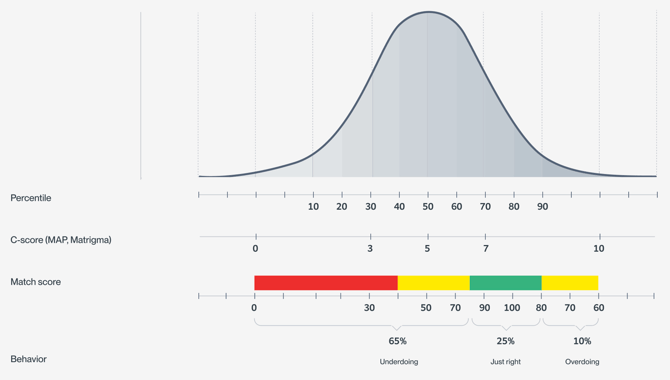
Standardization – Transformation into norm-referenced metrics (Z-score, C-score, percentile).
-
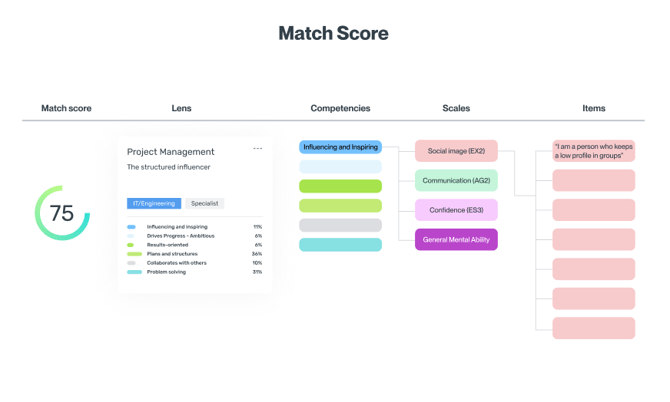
Competency scoring – Aggregation of multiple test scales into weighted competency percentiles.
-
Match scoring – Behavioral interpretation of each competency as underused, just right, or overused.
-
Lens scoring – Weighted integration of all competency match scores to produce an overall lens match score.
This structure ensures every number represents a behavioral and organizational meaning, not just a statistical result.
2. Step-by-Step Scoring Process
2.1 Raw Score → Standardized Score
Each test response is first normalized using validated norm groups:
-
MAP scales (personality-based) and Matrigma (cognitive ability) are standardized independently.
-
Each scale score is transformed into a Z-score, then into percentiles for easier interpretation.
This step allows results to be comparable across users, languages, and roles.
2.2 Standardized Score → Competency Percentile
Each competency is derived from 2–5 underlying test scales:
-
Every test scale contributes a specific weight to the competency.
-
These weights reflect the psychometric predictive validity of each scale for that competency.
-
The result is a compound percentile score, representing the individual’s behavioral strength for that competency.
For example, “Problem Solving” might include cognitive ability (Matrigma), logical reasoning, and openness to experience. Each of these inputs is weighted differently to produce a stable behavioral percentile.
3. Competency Match Scores
Competency percentiles are further transformed into match scores, incorporating:
-
Behavioral interpretation (“underused,” “just right,” “overused”),
-
The expected balance of performance per competency,
-
The role’s required behavioral intensity (from the lens weightings).
Example: A percentile score of 70% might represent:
-
“Underused” for Drives Progress,
-
“Overused” for Self-Awareness.
This layer brings contextual validity — acknowledging that the same trait can help or hinder performance in different ways.
4. Lens Match Scores
The lens match score represents overall fit to a job or organizational profile.
It integrates the weighted match scores of all competencies in the selected lens.
Rules for Lens Scoring
-
Lenses typically include 4–7 competencies, covering all four performance domains.
-
Some competencies weigh more heavily (e.g., “Problem Solving” for analytical roles).
-
The final score represents holistic behavioral alignment rather than isolated strengths.
Each lens maintains its integrity through internal weighting and domain balance constraints defined by the Performance Framework.
5. Dynamic Competency Transformations
Assessio applies a dynamic transformation model to improve fairness and accuracy across different GMA levels (general mental ability).
5.1 The Problem
Competencies with strong cognitive components (high GMA load) can distort match scores.
For example:
-
A moderate GMA score (5–6) may yield inflated match scores.
-
A very high GMA score (8–10) could reduce match scores too much.
5.2 The Solution
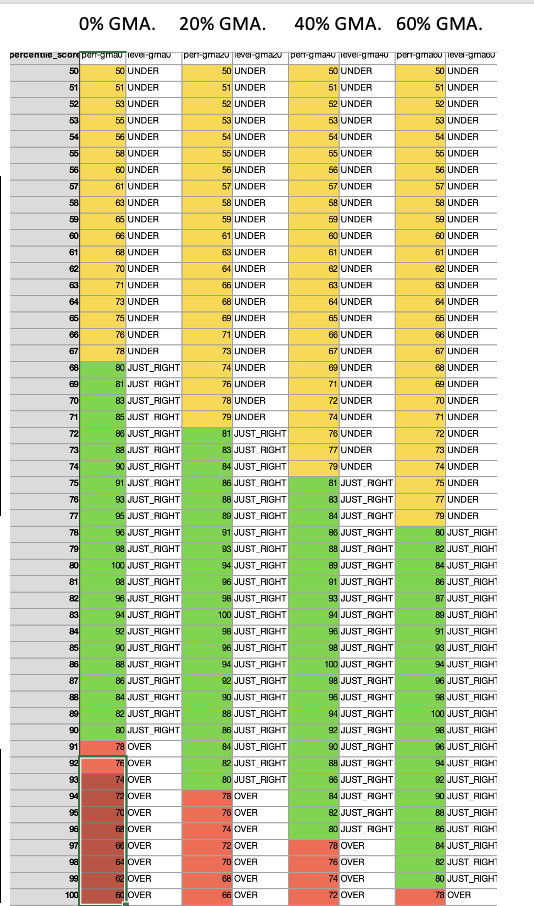
Dynamic transformation functions adjust competency curves depending on GMA weighting.
-
GMA weights range from 0% to 60%, depending on the competency.
-
Transformations ensure each competency behaves consistently across ability ranges.
Example (simplified):
Competency |
GMA Weight |
Old transformation |
New transformation |
Outcome |
| Problem solving | 60% | 70% → 90% | 70% → 84% | Less overestimation of average to high-GMA scores |
| Initiating action | 0% | 70% → 70% | 70% → 70% | Stable across all levels |
| Driving Leadership | 40% | 70% → 83% | 70% → 70% | Balanced effect between cognitive and behavioral components |
These transformations correct over- or underestimation effects and make the system equitable and predictive across roles:
6. Continuous Validation
Assessio’s scoring logic is continuously validated using:
-
Predictive analytics linking scores to real job performance data,
-
Cross-validation studies across industries and countries,
-
Ongoing calibration of norm groups and transformations.
This ensures every match score maintains scientific validity and practical interpretability over time.